 AW XVIII.5
 AW XVIII.4
 AW XVIII.3
 AW XVIII.2
 AW XVIII.1
 AW XVII.6
 AW XVII.5
 AW XVII.4
 AW XVII.3
 AW XVII.2
 AW XVII.1
 AW XVI.6
 AW XVI.5
 AW XVI.4
 AW XVI.3
 AW XVI.2
 AW XVI.1
 AW XV.6
Ancient Warfare is a unique publication focused exclusively on soldiers, battles, and tactics, all before 600 AD. Starting with ancient Egypt and Persia and continuing to the fall of the Western Roman Empire, Ancient Warfare examines the military history of cultures throughout Europe, the Middle East and parts of Asia and Africa. Ancient Greece and Rome receive the most frequent coverage, due both to the wealth of contemporary sources and the modern fascination with these two great civilizations. Subject-matter ranges from the familiar to the more obscure: while Alexander the Great, the Persian Wars and Caesar’s Gallic campaigns all receive regular coverage, Ancient Warfare also looks at some of the less common parts of ancient military history, from chariots as battle taxis to PTSD in antiquity.
Ancient Warfare Magazine
EDITORIAL — Peaceful century? • NEWS ITEMS BY LINDSAY POWELL
Mass grave of the Battle of Mursa identified?
Egyptian fortress discovered in North Sinai
Punic War helmet with cheek plates recovered from seabed
Roman citizen served with auxiliary unit in Spain
Vessel showing warriors found at Solar Observatory
Hellenistic fort discovered in western Turkey
HAVE YOU READ? • Ammianus Marcellinus: the Allusive Historian
Model Roman warship’s prow found in Salzburg
LATE ROMAN HEAVY CAVALRY • The emergence of heavy cavalry in European warfare is generally associated with the Frankish Empire and the Early Middle Ages, but numerous ancient sources prove that the Romans not only encountered heavy cavalry but also employed this branch of the military themselves. The roots of medieval European knightly combat can, therefore, be traced back to late antiquity, when heavy cavalry became a permanent feature on European battlefields.
Clibanarius versus catafractarius
The Fulcum
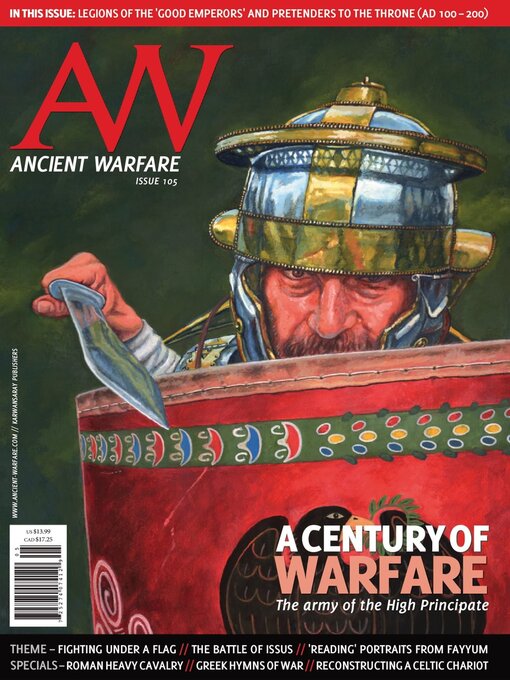
A CENTURY OF WAR • The second century AD epitomizes Roman Imperial warfare. The legionaries are equipped with the ‘typical’ lorica segmentata, rectangular scuta, gladius, and imperial helmet. The wars which bookend the century also typify Roman Imperial warfare — enemies, armour, equipment, and even tactics. Despite this ‘typical’ reputation, the second century also reveals transitions in armour, tactics, policy, and equipment.
FIGHTING UNDER A FLAG • During the second century AD, rather than entire legions, detachments marching under flag standards (vexilla) were often sent to deal with military threats. In peacetime, some were dispatched to construct or repair civil or military infrastructure. Deployment of these vexillationes was a result of units operating from bases at fixed, defensible points on the frontier of the empire, a policy requiring permanent garrisons to ensure border security.
A ROMAN CAREER SOLDER • For those with a talent for leadership, service in the Roman army offered promotion and status, financial security, and an opportunity to travel the empire. One such individual who took advantage of these opportunities was Marcus Valerius Maximianus, a soldier whose career in the later second century AD is one of the most astonishing individual military stories known from Roman history.
Legate, legate, legate, legate, legate
The Equestrian career path
A VERY SEVERAN CIVIL WAR • In AD 193, following the assassination of the Emperor Commodus, a civil war of enormous proportions shook the Roman Empire. The Romans had not witnessed an internal conflict of this magnitude since AD 69, the Year of the Four Emperors. AD 193 would go down in history under a very similar name: the Year of the Five Emperors (see also AW XIII.3).
A time of change
SIGNALLING ON A SMALL SCALE • When Roman soldiers marched into the lands beyond the Danube, they carried not only their weapons but also their sense of who they were. Every belt...